Design
PORTFOLIO
The Taytay Garment Shopping Hub
an architectural undergraduate thesis
Taytay, Rizal
A tiangge, as Filipinos call it, is composed of a large group of small enterprises selling a broad selection of low-cost items. A great number of entrepreneurs start with this kind of business in the country due to uncomplicated application processes and the fair amount required to begin with. In the eastern part of southern Luzon, in the province of Rizal, a municipality called Taytay is well-known for its myriad selection of tiangge. It is not only known to its bordering towns but throughout other cities around the nation as well.
The garment industry of the town is regarded as its primary business endeavor. Businesses attracted a lot of consumers outside Taytay which created an opportunity for the locals to be employed in the area. From only 400 registered sellers in 2010, it increased to 4,000 in 2017. It also takes pride in the quality of goods that are comparable to those being sold in malls. The place does not only provide inexpensive clothing, but also immerses the customer in the cultural context of the locality.

CONNECTIVITY
The concept of connectivity is divided into two different aspects, namely social and economical.
Social Aspect
Connections created by architecture are not limited to people - building interaction but also pertain to connections within the people. In a tiangge market, there is a mutualistic relationship among the supplier, seller and consumer in this type of market. By creating a healthy interaction between these parties, the market environment is bound to increase in positive quality.
Ecomical Aspect
Taytay is hailed as the garment capital of the Philippines, therefore driving its local people to enter the garment industry. The government recognizes this endeavor and strived to develop the tiangge, a common unit of shopping around the municipality. Considering this, the economic aspect of the project is tackled by the project to help the vendors in their businesses and ultimately improve the municipality’s business facet.


SITE ANALYSIS

SITE DEVELOPMENT


TIANGGE BUILDINGS


Wider Walkways
Interview data would suggest that users encountered uncomfortability in the current hallway dimensions of the tiangge. With this, they easily tire out due to the heat and hassle of maneuvering through which results in cutting their shopping trip earlier than expected. The stalls are set at 2m x 2m, considering practicality and existing dimensions. The hallways are set at 2.60 m with two auxiliary spaces flanking both sides set at 1.20 m. These auxiliary spaces account for the buying areas where consumers would stand during purchases.
Consumer Buying Area
The consumer buying area is based from the average maximum number of consumers that simultaneously visit a stall (4 persons/ stall), to avoid crowding along the hallways
Storage
Lack of storage for every stall halls also contributed to the congestion along the walkways. The new stall designs provide storage on top of the stalls to: avoid obstructing the walkways and allow for larger storage spaces.
Modular Design
The stalls are modular in nature and if the seller requires it, divisions may be removed accordingly to accommodate larger stall spaces. Once contracts lapse, the divisions may then be returned in place to accommodate a new seller.


Facade
The orientation of these panels are based on the sun orientation and its intensity during the daytime, and the direction of the northeastern monsoon
Color Theory
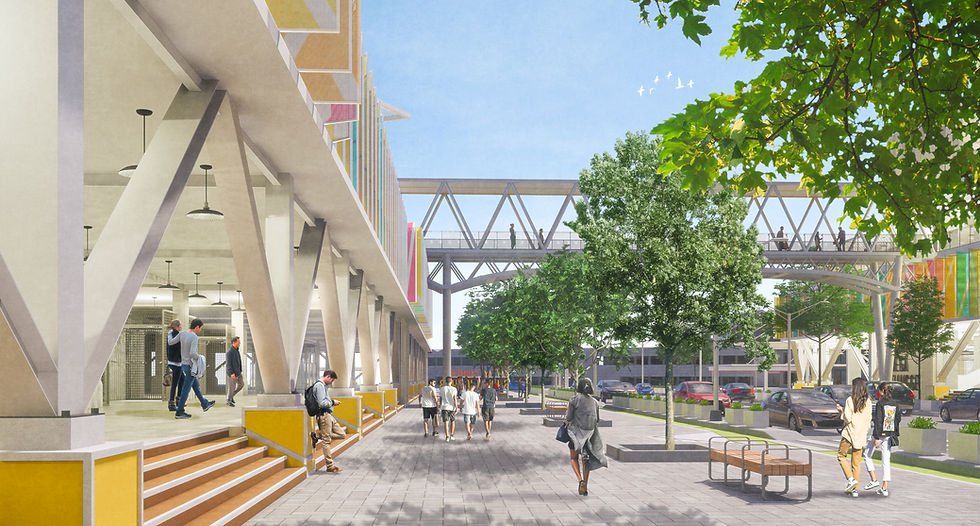
Colors evoke certain moods depending on how and what colors were used. The tiangge buildings utilized yellow, orange, blue and pink for their psychological effects on the users.




Pedestrian Access
The bridge connects the third floor of both tiangge buildings, contrinuting to the continuous flow of space from one building to another.


MULTI-PURPOSE BUILDING AND OUTDOOR PARK

Event Configuration


FOODCOURT


PARKING


ARCHITECTURAL BAY SECTION

